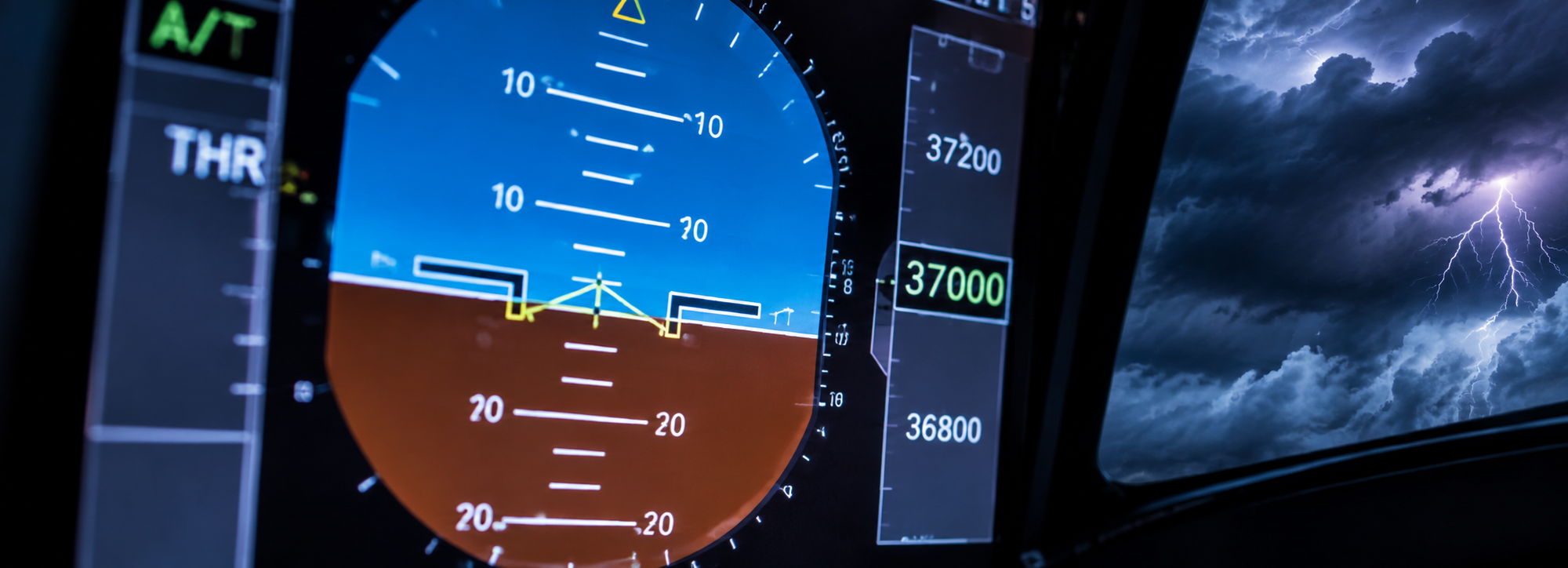
Those who know me are familiar with my interest in aviation. Whenever a plane crashes, I don’t simply read the headlines. I want to understand what caused the accident. I’m particularly interested in the decisions made by pilots, because sometimes an accident is not caused by a technical failure alone, but by how people respond to it. Of course, pilots can make mistakes. What interests me most, however, is why people who have undergone years of training and accumulated thousands of flight hours sometimes make errors that seem so obvious in hindsight.
When I read about the Learjet 60 crash in Palm Beach County, Florida, on November 1, 2026, which claimed nine lives, another accident immediately came to mind. But before explaining that connection, it’s worth looking at what happened during the Learjet’s final minutes.
The private jet was flying from Texas to the Bahamas. In the cockpit were 55-year-old captain Jeff Gregory and 20-year-old first officer Nathalia Gadelha Filgueiras. Nathalia had accumulated approximately 1,300 flight hours. She had earned her pilot’s license while still in high school and later became a flight instructor. Her background shows that she had already gained professional flying experience, although her total flight time was still relatively limited.
At approximately 35,000 feet, the aircraft encountered adverse weather conditions. Radio communications with air traffic control included reports of icing, turbulence, and precipitation. The pilots also reported significant altitude deviations caused by turbulence. They subsequently requested permission to climb to 37,000 feet. Nathalia was the pilot communicating with air traffic control.
That request to climb was the detail that particularly caught my attention. The pilots were apparently trying to reach a higher altitude to escape the adverse weather. Shortly after clearance was granted, however, the aircraft began losing altitude at an alarming rate. Radio transmissions referred first to descent rates of 8,000 and 10,000 feet per minute, then approximately 20,000 feet per minute. The Learjet eventually crashed, killing all nine people on board.
My first question was whether, in attempting to escape the storm, the pilots might have brought the aircraft closer to its aerodynamic limits.
We don’t know that yet. The cause of the crash will have to be established by the official investigation. Still, the combination of icing, high altitude, a request to climb, and the subsequent loss of control reminded me of another tragedy over the Atlantic Ocean 17 years earlier.
On June 1, 2009, an Air France Airbus A330 was flying from Rio de Janeiro to Paris when it encountered severe weather over the Atlantic. Ice crystals obstructed the aircraft’s Pitot probes, causing unreliable airspeed indications. The autopilot disconnected, leaving the pilots to fly the aircraft manually. One of the first officers pulled back on the sidestick, raising the aircraft’s nose. The aircraft initially climbed, then lost aerodynamic lift and entered a stall.
A stall does not mean that the engines have stopped, as many people assume. It occurs when the wings exceed their critical angle of attack and can no longer generate sufficient lift. To recover, the pilot must reduce the angle of attack and restore proper airflow over the wings. This generally requires lowering the aircraft’s nose.
On Air France 447, however, the pilot continued pulling back on the sidestick as the aircraft lost altitude. Its nose remained high, but the aircraft was descending rapidly. Although the engines were running, the wings were no longer producing enough lift. The pilots failed to correctly identify the aircraft’s condition in time, and after approximately four minutes of uncontrolled descent, the Airbus crashed into the Atlantic Ocean. All 228 people on board were killed.
There is an important distinction here. It would be inaccurate to describe the Air France pilot’s initial nose-up input as a deliberate attempt to climb above the storm. The official investigation identified inappropriate control inputs following unreliable airspeed indications and the crew’s failure to recognize the stall. The continued nose-up inputs while the aircraft was descending were central to the accident.
This is where I see a possible connection with the Learjet crash. Both aircraft encountered adverse weather at high altitude. On Air France 447, ice crystals interfered with airspeed measurement; on the Learjet, the pilots reported icing and turbulence. We know with certainty that Air France 447 entered a stall. Whether the Learjet crashed for the same reason remains unknown. However, the limitations of aircraft performance at high altitude are relevant to understanding both situations.
In aviation, there is a phenomenon known as the coffin corner. At very high altitudes, the lower speed boundary associated with aerodynamic stall and the upper boundary associated with high-speed aerodynamic limitations begin to converge. The aircraft’s safe operating speed range becomes increasingly narrow. This does not occur at the same altitude for every aircraft; it depends on the aircraft’s design, weight, and operating conditions. Icing can further degrade aerodynamic performance by altering airflow over the wings.
This is why the request to climb from 35,000 to 37,000 feet caught my attention. Without knowing the Learjet’s weight, actual airspeed, wing condition, and available climb performance, we cannot conclude that the decision was wrong. But I believe it is one of the factors investigators should examine closely.
Another aspect of these accidents that interests me is the relationship between the people in the cockpit.
The Learjet’s captain was 55, while the first officer was only 20. There was a 35-year age difference between them. Nathalia had accumulated approximately 1,300 flight hours, which may sound impressive for someone her age, but it is still relatively limited experience in professional aviation. More importantly, total flight hours tell us little about how much experience a pilot has in a particular aircraft, in severe weather, or in handling unexpected emergencies at high altitude. We also don’t know how comfortable she felt questioning the decisions of a much older and more experienced captain.
In aviation, this is known as the cockpit authority gradient. A certain hierarchy between the captain and first officer is natural. After all, the captain has ultimate responsibility for the aircraft. However, when that hierarchy becomes too pronounced, the less experienced pilot may find it difficult to question the captain’s decisions.
This is not a problem unique to aviation. Most of us have experienced similar situations in the workplace. Perhaps you have doubted a decision made by someone far more experienced than yourself but remained silent because you assumed they knew better. Sometimes people hesitate to speak up because they fear their objections may be misunderstood. In a cockpit, such communication problems can have far more serious consequences.
So, did Nathalia agree with the decision to climb? Did she suggest an alternative route or altitude? Was there any disagreement between the two pilots? We simply don’t know. The fact that Nathalia was communicating with air traffic control does not establish that she was making the decisions. In aviation, radio communications are generally handled by the pilot who is not flying the aircraft at that moment.
I believe the cockpit’s decision-making process deserves careful examination. One of the central purposes of modern Crew Resource Management (CRM) training is to improve communication between captains and first officers. A first officer is expected to challenge the captain when necessary, and the captain is expected to take those concerns seriously. Having two pilots in the cockpit is not simply about dividing responsibilities. It is also about ensuring that each can monitor and question the other’s decisions.
Cockpit communication also played an important role in the Air France 447 accident. The control inputs made by the pilot flying complicated the other pilots’ understanding of what was happening. Stall warnings, unreliable airspeed indications, and failures in communication combined to prevent the crew from recognizing the aircraft’s condition in time.
Human psychology must also be considered. Throughout their training, pilots learn about stalls, loss of control, and various system failures. They encounter these situations in simulators and practice the appropriate responses. But in a real emergency, particularly when events unfold unexpectedly, human reactions can differ considerably from those demonstrated during training.
In aviation, the startle effect describes the surprise caused by an unexpected event and its impact on a person’s ability to respond. Under intense stress, attention can narrow, and people may focus on a particular instrument or assumption while overlooking other important information. During night flights, when there is no reliable visual horizon, the human vestibular system can also produce misleading sensations. This is why pilots must learn not only how to control an aircraft, but also how to interpret information and make decisions under unexpected conditions.
Following the Air France 447 accident, greater attention was given to training involving high-altitude stall recovery and unreliable airspeed indications. Air France itself introduced revised emergency manoeuvre training for its Airbus crews in 2010 and Boeing crews in 2011. The lessons also contributed to wider changes in the aviation industry. The FAA subsequently developed guidance on stall prevention and recovery and on Upset Prevention and Recovery Training (UPRT), drawing on work involving aircraft manufacturers, airlines and aviation safety organizations. These principles were not intended to benefit Airbus and Boeing pilots alone; the FAA has also encouraged other operators and training organizations to adopt them.
This brings me to another question about the Learjet crew. Under certain U.S. commercial operating rules, pilots undergo recurrent knowledge and competency checks, while captains conducting instrument flights must also complete instrument proficiency checks at six-month intervals. The exact requirements depend on the type of operation, and a six-month proficiency check is not necessarily the same thing as a complete ground school course. We do not yet know the details of Gregory’s and Nathalia’s recurrent training.
But had these two pilots been trained on the lessons of Air France 447? Had they practised recognizing and recovering from a high-altitude stall, particularly when icing, unreliable indications or an unexpected loss of control complicated the situation? And if they had received such training, would it have been enough to help them recognize a similar emergency in time? These are questions I would like to see addressed during the investigation, especially since the aircraft involved was a Learjet rather than an Airbus or Boeing.
Even with such training, making the correct decision during a genuine emergency is not always easy, particularly when there is very little time to understand what is happening.
This is why I am reluctant to blame pilots immediately after an accident. Once the investigation is complete and all the evidence is available, it is relatively easy to identify the wrong decision and explain what should have been done. The people in the cockpit, however, do not know how the event will end. They may also lack information that investigators will only discover much later.
We now have a detailed understanding of what happened to Air France 447. The investigation into the Florida Learjet crash, on the other hand, is only beginning. It is too early to say whether the two aircraft were lost for the same reason. The reports of icing, turbulence, the request to climb, and the subsequent rapid descent bring back important lessons from Air France 447.
What interests me is not only why the Learjet crashed, but also what the two pilots were thinking during those final minutes and what information they were using to make their decisions.
Aviation safety depends on more than aircraft technology. It also depends on communication between pilots, their ability to recognize unexpected situations correctly, and their willingness to reconsider a decision when circumstances change.
Seventeen years have passed since Air France 447. Much has been learned from that accident, training practices have evolved, and new safety measures have been introduced. I hope the investigation into the Florida Learjet crash will provide further lessons.
In particular, I hope it will help answer one question: How can a pilot recognize that a decision intended to save an aircraft is wrong while there is still time to change it?
Victoria Toumit