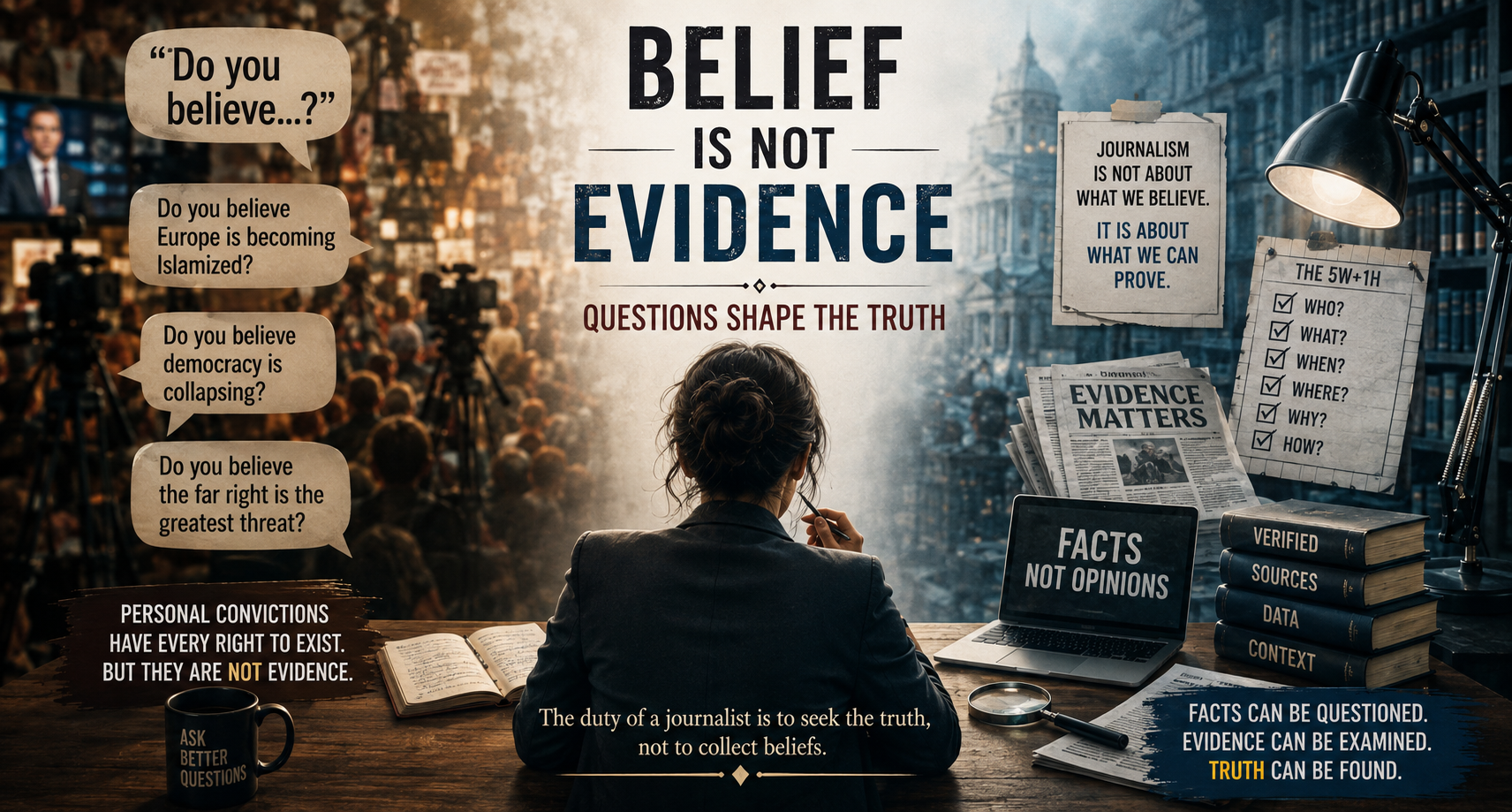
I’ve been watching journalism change before my eyes. Most people probably don’t even realize it’s happening because the change isn’t in the content itself, but in the way questions are asked. Watch television interviews, podcasts, or political discussions, and you’ll increasingly hear the same phrase:
“Do you believe…?”
At first glance, it sounds like an innocent question. But in reality, it quietly changes one of journalism’s most fundamental principles. From that moment on, the conversation is no longer driven by evidence; it is driven by personal conviction.
Traditionally, the phrase “Do you believe…?” has a very specific role in English. It is used when discussing subjects that cannot yet be proven, verified, or objectively demonstrated. “Do you believe in God?” “Do you believe in ghosts?” “Do you believe there is intelligent life elsewhere in the universe?” These are all questions whose answers cannot be established with definitive evidence. The interviewer is not asking for facts, but for the interviewee’s personal belief. That is precisely the purpose of the question.
The problem begins when the same linguistic pattern is transferred into political journalism. Increasingly, journalists ask “Do you believe…?” even when discussing subjects that should be examined through evidence. “Do you believe Europe is becoming Islamized?” “Do you believe democracy is collapsing?” “Do you believe the far right is the greatest threat?” Notice something important: none of these questions asks the interviewee to provide evidence. They simply invite a statement of belief.
This is where my concern begins. The moment a journalist asks me what I believe, I am no longer required to support my answer with evidence. I can express any political opinion or ideological conviction I like without presenting a single fact. The journalist appears to have done the job, but the essential question was never asked. Imagine instead if the interviewer had said: “What evidence supports that conclusion?” “Which data are you relying on?” “What historical examples lead you to that view?” That is where journalism begins.
I entered journalism in the late 1980s and worked throughout the 1990s. The very first principle we were taught was the Five Ws and One H: Who, What, When, Where, Why, and How. Every one of these questions is designed to establish facts. Who did it? What happened? Where did it happen? When did it happen? Why did it happen? How did it happen? None of them asks, “What do you believe?” because journalism was never meant to collect beliefs. Its purpose is to investigate reality.
What concerns me most is that audiences often fail to notice this shift. When a serious-looking interviewer asks “Do you believe…?” on a respected news program, many viewers unconsciously process the answer as though it were a factual statement. In reality, they have only heard someone’s personal conviction. Personal convictions have every right to exist, but they are not evidence. Journalism, on the other hand, was never meant to collect convictions. It was meant to examine facts.
Victoria Toumit
DO YOU BELIEVE…?